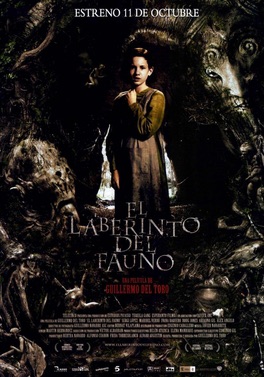
Pan’s Labyrinth (El laberinto del fauno, 2006), directed by Guillermo del Toro, is not a fairy tale in the comforting sense, it’s a dark, aching fable about innocence colliding with brutality, imagination battling authoritarianism, and the terrible cost of moral choice.
Set in Post–Spanish Civil War Spain, the film follows Ofelia, a bookish young girl who escapes the cruelty of her reality by slipping into a mythic labyrinth overseen by a mysterious Faun. Parallel to her fantastical trials is the harsh world of her stepfather, Captain Vidal, a fascist officer obsessed with obedience, legacy, and control. The film never lets one world exist without the other; fantasy and violence are in constant, unsettling conversation.
What makes Pan’s Labyrinth extraordinary is how fantasy is not an escape, but a test. Del Toro uses fairy-tale symbolism to explore obedience versus disobedience, innocence versus complicity. The creatures, especially the Faun and the Pale Man, are unforgettable not just visually, but thematically: they embody moral ambiguity, temptation, and the danger of blind submission.
Visually, the film is stunning. Earthy golds and mossy greens dominate the fantasy world, while cold blues and grays suffocate the real one. Practical effects give the creatures a tactile, storybook-turned-nightmare quality that CGI could never replicate. Javier Navarrete’s haunting score, built around a lullaby, reinforces the sense that this is a bedtime story whispered in a war zone.
Emotionally, the film is devastating. It refuses easy comfort or clean endings. Instead, it asks whether choosing kindness and defiance, especially when powerless, is itself a form of victory. Ofelia’s courage is quiet, stubborn, and deeply human.
Pan’s Labyrinth is a masterpiece of dark fantasy and historical allegory. It’s beautiful, terrifying, and profoundly sad, proof that fairy tales can be weapons against tyranny, and that imagination can be an act of resistance.
 From the Alter Steps