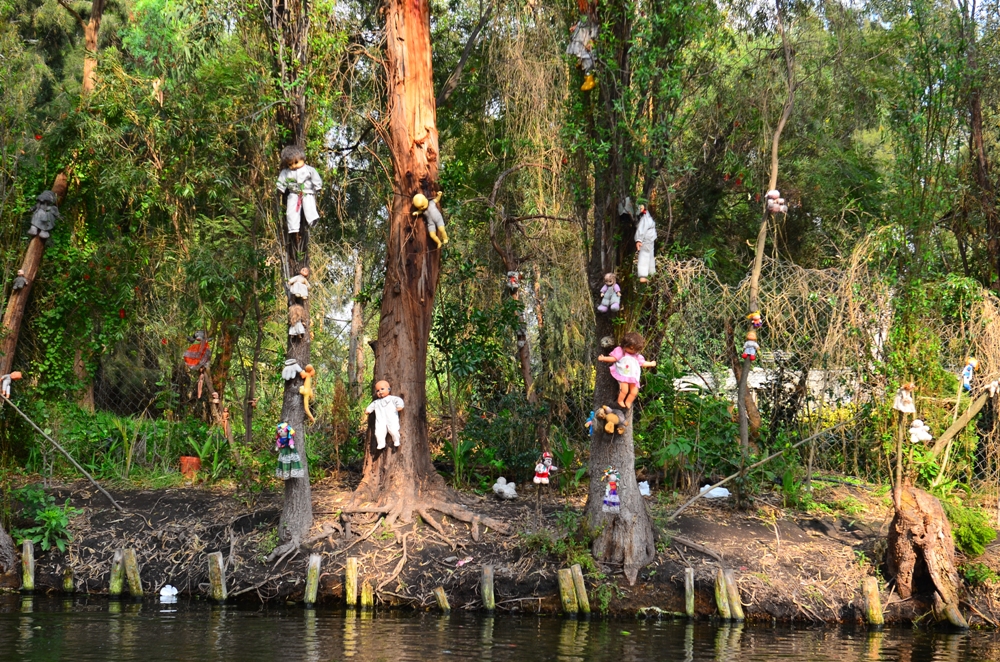
Hidden deep within the canals of Xochimilco lies Island of the Dolls, a place that feels less like a destination and more like a psychological text left unfinished. Known locally as Isla de las Muñecas, this small island is draped in hundreds of decaying dolls, their cracked faces and hollow eyes fixed eternally on the water.
This is not horror designed for spectacle. It is horror born of obsession, grief, and isolation.
A Solitary Origin Story
The island’s unsettling transformation began with Don Julián Santana Barrera, a reclusive man who lived alone on the island for decades. According to local legend, he discovered the body of a young girl drowned in the nearby canal. Soon after, he found a doll floating in the water and hung it from a tree, an offering, a ward, or perhaps an apology.
He never stopped.
Over the years, Don Julián collected dolls discarded in the canals, hanging them across the island in varying states of decay. He claimed they were meant to appease the girl’s spirit. Others believe they were meant to keep him company.
The Island as an Archive of Decay
The dolls, missing limbs, clouded eyes, matted hair, form an accidental archive of abandonment. Time, humidity, insects, and mildew annotate every plastic face. Some are nailed to trees. Others dangle from wires like footnotes written in rot.
In dark-academia terms, the island reads like a thesis on unprocessed grief, how memory, when left alone too long, curdles into fixation.
Death Imitates Legend
In 2001, Don Julián was found drowned in the same canal where the girl was said to have died, fueling the island’s mythology and sealing its reputation as one of the most haunted places in the world. Whether coincidence or narrative symmetry, the ending feels disturbingly intentional, as if the island demanded a final citation.
Why the Island Endures
The Island of the Dolls does not rely on jump scares or spectacle. Its horror is slow, observational, and deeply human. Visitors arrive by boat, drifting past reeds and silence, confronted by hundreds of faces that do not blink, faces that once belonged to children, now stripped of innocence.
It is a place that asks uncomfortable questions:
• What happens when grief is never interrupted?
• Can devotion become desecration?
• At what point does protection turn into possession?
A Place to Be Observed, Not Explained
Like any powerful dark-academia site, Isla de las Muñecas resists closure. There is no moral, no clean ending, only the uneasy knowledge that memory, when left to rot in solitude, can become something monstrous.
Here, the past does not rest.
It watches.
 From the Alter Steps