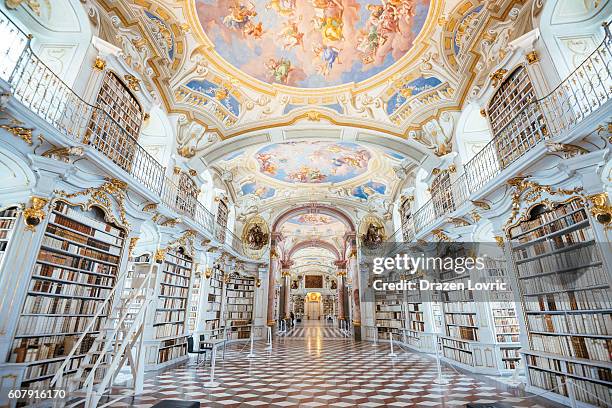
At first glance, the Admont Abbey Library feels like a contradiction.
This is dark academia without darkness, an intellectual sanctuary flooded with light, order, and quiet intensity. Where most historic libraries rely on shadow and gloom, Admont overwhelms with clarity. And somehow, that makes it just as haunting.
The World’s Largest Monastic Library
Completed in 1776, Admont Abbey Library is the largest monastic library in the world. Stretching across seven domes and nearly 70 meters, the hall feels less like a room and more like a philosophical statement.
White and gold shelves rise in perfect symmetry, holding over 70,000 volumes, theological works, scientific treatises, philosophy, history, and early encyclopedias. This is knowledge arranged not to intimidate, but to be contemplated.
If the Long Room in Dublin feels like a cathedral at dusk, Admont feels like one at dawn.
Light as an Intellectual Force
Natural light pours in through high windows, illuminating frescoes by Bartolomeo Altomonte that depict the stages of human knowledge, from divine revelation to reason and science.
The message is unmistakable:
learning is sacred, but it is also rational, disciplined, and meant to be pursued without fear.
Dark academia often romanticizes isolation and obsession. Admont offers something quieter: devotion through balance.
Order, Enlightenment, and Control
Built during the Enlightenment, the library reflects an era obsessed with classification, symmetry, and intellectual mastery. Even the sculptures, representing the Four Last Things and human virtues, are placed with careful intention.
Nothing here is accidental.
Nothing is chaotic.
And that perfection is what makes the space unsettling in its own way. It asks uncomfortable questions:
- Can knowledge ever be neutral?
- Does order tame curiosity, or sharpen it?
- What is lost when everything is cataloged?
Visiting Admont Abbey Library
- Located in Styria, Austria, surrounded by Alpine landscapes
- Best visited mid-morning, when the light fully reveals the frescoes
- Take time to look up, not just at the shelves
- Pair with the abbey’s museum collections for deeper context
Final Reflection
Admont Abbey Library is not a place to get lost, it’s a place to be contained.
Where other libraries invite wandering, Admont invites contemplation. It reminds us that knowledge has long been curated, controlled, and elevated, and that beauty has always been one of its most persuasive tools.
For lovers of dark academia, this is the brighter side of the obsession, and perhaps the more dangerous one.
 From the Alter Steps